A screw compressor suits continuous production when the plant has a sustained base-load air demand, long operating hours and a need for stable pressure. You will be able to measure actual demand, size the compressor and receiver, choose between fixed-speed and VFD control, and identify the air-treatment and redundancy requirements before approving an installation.
Key takeaways
- Choose a screw compressor for sustained base-load demand across long operating hours.
- Measure average flow, peak flow and leakage before selecting capacity.
- Match compressor controls and receiver volume to the plant’s demand pattern.
- Specify air quality, cooling, redundancy and service before approving the package.
Start with the Air-Demand Pattern, Not the Motor Size
An industrial screw compressor suits continuous manufacturing when the plant has steady air demand across long operating hours, repeated production shifts and a need for stable pressure. The key test is sustained base-load demand, not the motor’s nameplate size. A large motor cannot make an intermittent process economical.
The machine is a strong fit when production consumes compressed air for most of each shift and unload periods are short. A reciprocating compressor is often cheaper for low average flow, occasional operation or long idle periods because a screw compressor loses its advantage when it spends much of the day unloaded.
Continuous operation does not mean running at full load without interruption. The compressor must follow the plant’s demand without excessive cycling, and a single variable-speed unit can become inefficient at very low flow because its minimum speed limits turndown.
A steady base load supports efficient operation; sharp, frequent demand changes require a control strategy designed for them.
Room conditions also decide suitability. Provide ventilation that removes the package’s continuous heat output, because excessive inlet or discharge temperature raises trip risk and accelerates lubricant degradation.
Heat recovery improves the case when compressor operation coincides with a need for hot water or process preheating; count it only after confirming the heat sink, temperature and schedule. Plan condition-based service and condensate handling before committing to long operating hours.
Measure Average Flow, Peak Flow and Leakage Before Sizing
A nameplate horsepower figure does not tell you the compressor capacity your plant can use. Size from measured delivered flow at the required pressure, then check the result against average demand, peak demand and leakage.
1. Install a calibrated flow meter and a data logger on the main compressed-air line. Record cubic metres per minute and pressure at short intervals through a representative production cycle, including shift changes, start-up and cleaning. Convert units when comparing suppliers: 1 cubic metre per minute equals approximately 35.31 cubic feet per minute.
2. Calculate the average flow over the full operating period, not just the busiest hour. This figure defines the sustained base load. Compare it with the manufacturer’s tested delivered flow at your specified inlet conditions and discharge pressure; ISO 1217 test data is more useful than motor horsepower.
3. Identify the highest recorded flow and its duration. A receiver can cover a brief peak, stabilize pressure and prevent rapid cycling, but it cannot support a prolonged peak when average demand exceeds installed compressor capacity.
4. Measure leakage during a production shutdown with all points of use closed. The flow shown by the meter is leakage-driven demand; add it to production demand or repair the leaks before sizing.
Set pressure from the minimum required at the point of use, after piping, filters, dryers, valves and peak-flow losses. Raising discharge pressure to overcome a restriction increases energy consumption and can mask an undersized or poorly maintained system.
Match Controls, Receiver Volume and Pressure to the Demand Profile
Choose a fixed-speed compressor for a stable base load, a VFD compressor for sustained demand variation, and a larger receiver tank for short peaks or frequent cycling. Match the choice to the duration and frequency of each demand change, not to the motor’s nameplate horsepower.
| Option | What it means | When it applies |
|---|---|---|
| Fixed-speed compressor | Runs loaded or unloaded at a set speed | Choose it when demand stays near a steady base load for long periods. It operates efficiently near full load and suits a multi-compressor base-load arrangement. |
| VFD compressor | Changes motor speed to follow flow | Choose it when production demand moves across a wide range for sustained periods. Avoid relying on one VFD compressor at very low flow; minimum speed, oil circulation and motor cooling limit useful turndown. |
| Larger receiver tank | Stores compressed air between demand and supply | Choose it for brief peak flows, pressure stabilisation or to reduce rapid load/unload cycling. It cannot cover a prolonged peak that exceeds installed compressor capacity. |
A common arrangement uses fixed-speed compressors for base load and one VFD compressor as the trim machine. Add receiver volume when demand pulses last seconds or minutes; increase compressor capacity when the average flow remains above available output.
Set the pressure setpoint from the pressure required at the point of use, after accounting for piping, dryers, filters, valves and peak-flow losses. Raising discharge pressure to hide a restriction wastes energy. Compare tested delivered flow at the specified pressure, not horsepower alone.
Compare a Screw Compressor with Other Ways to Maintain Production
Choose a screw compressor when production needs a sustained base load, repeated shifts, and stable pressure for long annual operating hours. Its continuous-duty design usually suits this pattern better than a reciprocating compressor, which is economical for intermittent demand, low average flow, or long unloaded periods.
| Option | Better choice when | Main limitation |
|---|---|---|
| Screw compressor | Demand is steady and the machine will run for long loaded periods | Part-load efficiency falls if demand varies widely |
| Reciprocating compressor | Flow is intermittent, modest, or pressure must rise sharply | Frequent cycling and long loaded periods increase wear and heat |
| Centrifugal compressor | The plant has very high, stable flow and a large operating base | High capital cost and minimum-flow limits make small or variable systems unsuitable |
| Multiple compressors | You need staged capacity, easier maintenance, or a backup compressor | Extra controls, piping, dryers, and isolation valves add complexity |
| Rental compressor | A shutdown, seasonal peak, or failed machine creates a short-term gap | Rental cost and temporary connections make it poor for permanent base load |
Compare delivered flow at the specified inlet condition and discharge pressure, input power, control mode, sound level, and part-load performance—not nameplate horsepower. Ask for performance data tested to ISO 1217.
Multiple compressors become preferable when one unit can be isolated without stopping production, but size the backup compressor for the required contingency load. A rental compressor is the faster remedy for an emergency; it is rarely the efficient foundation for a permanent process.
Specify Air Quality, Cooling, Redundancy and Service Around the Package
Specify air treatment by the required ISO 8573-1 class, not by the compressor label. The standard rates particles, water and oil separately. Oil-free air does not automatically mean particle-free or dry air; oil-injected compressed air needs correctly rated separators and filters when the process has a tight oil limit.
A refrigerated dryer suits air requiring about +3 °C pressure dew point, while desiccant drying suits requirements near -40 °C. Size the dryer for the coldest exposed pipe, not the compressor-room temperature.
Check these installation conditions before approving the package:
- Provide ventilation that removes compressor heat and keeps intake air away from dust, vapour and exhaust.
- Confirm the cooling system remains within its rated ambient temperature during the hottest production period.
- Install isolation valves, bypasses and a receiver so one compressor or dryer can be removed without stopping the line.
- Size the standby compressor for the required contingency load, not merely for the label “backup.”
- Route condensate from an oil-injected machine to an oil-water separator or an approved collection system; do not send it straight to a drain without checking local rules.
Automatic drain valves need failure monitoring. A stuck-open drain wastes air continuously.
Ask SMART - TECH COMPRESSORS to document separator loading limits, discharge-temperature alarms, lubricant requirements and a service schedule based on load profile, contamination and condensate conditions. Plan maintenance during production windows, with filters, separators and lubricant available before shutdown. Condition monitoring gives you warning; a nominal operating-hour interval alone does not.
Related products
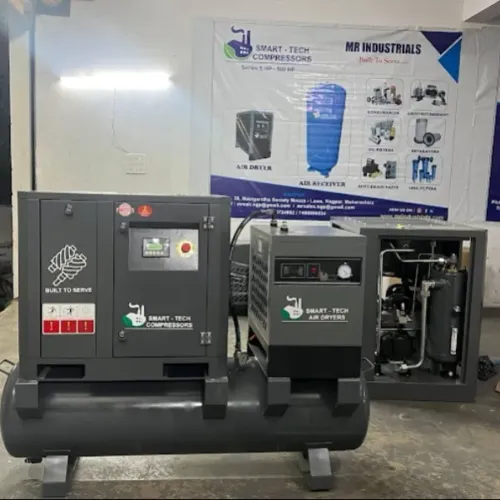
 | Tank Mounted 10HP TANK MOUNTED MODEL FOR PACKAGING INDUSTRIES Tank mounted complete package rotary screw air compressor specially built for small industries with affordable prices and service. |
 | Rotary Screw Air Compressor Smart -Tech Compressors Upto 300 HP We brought Special customised machine for customers , very cost effective and breakdown free , long life with energy saving and low maintenance... |
Frequently asked questions
When is an industrial screw compressor suitable for continuous manufacturing?
It suits plants with steady base-load air demand across long operating hours, repeated shifts and a need for stable pressure.
What air-demand measurements are needed before sizing a screw compressor?
Measure average flow, peak flow and leakage so the compressor is sized for actual demand rather than motor nameplate size.
How do controls and receiver volume affect compressor selection?
Controls and receiver volume must match demand changes, while the pressure setting must meet production requirements without creating unnecessary energy use.
How does a screw compressor compare with other ways to maintain production?
Compare it with reciprocating compressors, multiple smaller units and other system arrangements based on duty cycle, peak demand, efficiency and redundancy.
What should you specify beyond compressor capacity?
Specify air quality, cooling, redundancy, receiver configuration, controls, installation requirements and a practical service plan.
Related products
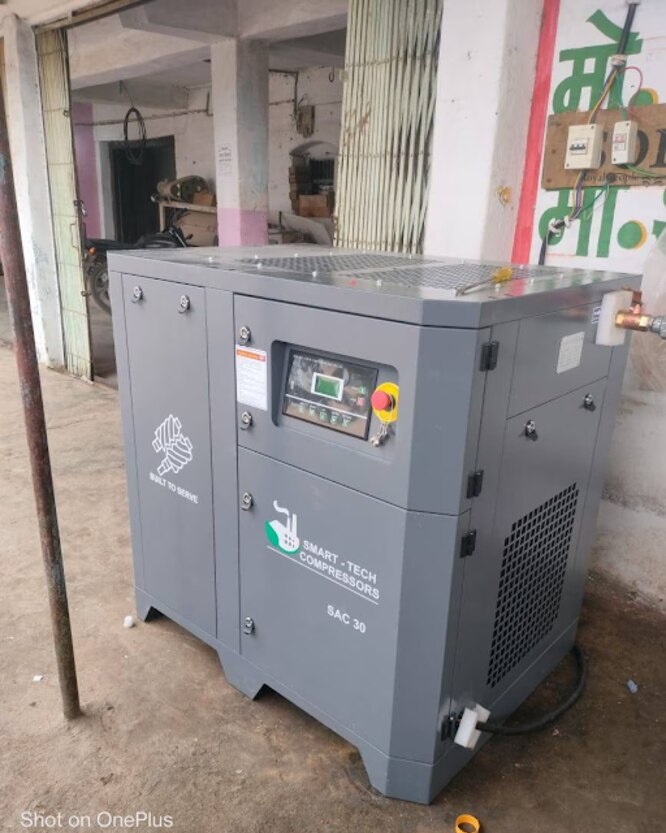
 | Rotary Screw Air Compressor Smart -Tech Make 30 HP Fix Speed Compressor ₹310000 Smart -Tech compressors braught a customised machine for customers very good in Quality , low cost , energy saving , low maintenance cost , fast... |
 | Rotary Screw Air Compressor SMART -TECH MAKE 25 HP VFD COMPRESSOR ₹380000 Smart -Tech compressors braught a customised machine for customers very good in Quality , low cost , energy saving , low maintenance cost , fast... |
 | Rotary Screw Air Compressors braught a customised machine for customers very good in Quality , low cost , energy saving , low maintenance cost , fast service availability , and 5... View product → |
 | Rotary Screw Air Compressor 50HP SMART -TECH VFD COMPRESSOR PREMIUM MODEL PREMIUM RANGE ROTARY SCREW AIR COMPRESSOR 50HP VFD MODEL WITH VERY AFFORDABLE PRICE AND MORE WARRANTY THAN ANY BRAND |