Industrial buyers frequently compare air compressors using horsepower, pressure rating and quotation price. Those figures matter, but they do not provide enough information to determine whether a compressor will perform efficiently in a real production environment. Evaluating an Air Compressor Manufacturer requires a broader review of application requirements and long-term ownership.
For businesses in Nagpur and across Maharashtra, a systematic buying process can reduce the risk of capacity problems after installation.
Define the Application Before Comparing Models
Start by documenting how compressed air is actually used.
A workshop using pneumatic tools intermittently has a different demand profile from a packaging facility running automated machines throughout multiple shifts.
Record required pressure, airflow, daily operating hours and major consuming equipment.
Where an existing system is being replaced, operating data from the current compressor can provide valuable guidance.
Avoid Selecting by Motor Rating Alone
Motor kilowatt or horsepower does not tell the complete story.
Buyers should compare delivered airflow at the required pressure and consider how the compressor responds to the expected load.
Two systems with apparently similar motor sizes may not provide identical performance under the same working conditions.
Include Air Treatment in the Buying Decision
Compressed air can contain moisture, particles and other contaminants.
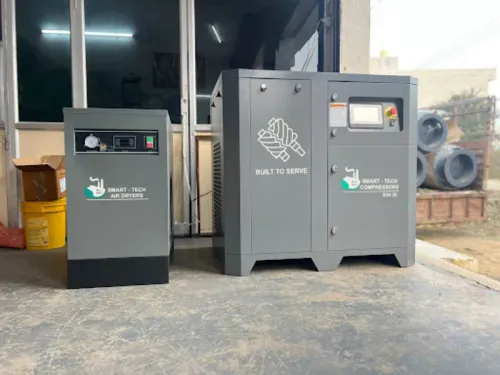
Depending on the process, the installation may require dryers, filters, separators and condensate-management equipment.
Buying the compressor first and considering air treatment later can lead to an incomplete system design.
Calculate Ownership Cost
A practical compressor comparison should include more than capital cost.
Consider:
- Electricity consumption
- Expected operating hours
- Maintenance frequency
- Consumable costs
- Spare-part accessibility
- Potential downtime
- Air-treatment requirements
For equipment running many hours each year, operating efficiency can have a major influence on total ownership cost.
Inspect the Proposed Installation Area
Before ordering equipment, confirm that the intended compressor room is suitable.
There should be adequate ventilation, sufficient service clearance and an appropriate route for piping and electrical connections.
Hot-air recirculation and excessive dust should be addressed before commissioning.
Establish a Maintenance Plan
Routine servicing should begin according to operating hours and manufacturer recommendations rather than waiting for performance to deteriorate.
Operators can also perform regular visual checks for leakage, abnormal sound, unusual temperature and condensate drainage problems.
A documented maintenance programme provides greater visibility into equipment condition.
Consider Local Service Capability
For production-dependent equipment, response capability can matter almost as much as technical specifications.
MR Industrials supplies and supports industrial compressed air equipment for businesses in Nagpur. Companies evaluating a new compressor can consider local access to technical guidance, compressor parts and service as part of their procurement decision.
Frequently Asked Questions
What details are needed for compressor selection
Airflow, operating pressure, application, operating hours, demand variation, air-quality requirements and expansion plans are useful starting points.
Is purchasing extra capacity a good idea
A sensible future allowance may be appropriate, but excessive oversizing can reduce operating efficiency.
Should piping be reviewed when replacing a compressor
Yes. Existing piping may have leakage, restrictions or insufficient diameter for increased production demand.
The right Air Compressor Manufacturer should be assessed through the complete lifecycle of the equipment, from initial sizing and installation to efficiency, maintenance and future production requirements.
Keywords