A compressor selected by horsepower and purchase price alone can deliver the wrong flow, consume excessive electricity, or leave production exposed when a controller, separator, dryer, or pressure vessel fails. By the end, you will have a practical way to compare manufacturers on measured capacity, air quality, operating cost, documentation, warranty scope, and long-term support.
Key takeaways
- Measure average and peak flow before comparing compressor motor sizes.
- Compare fixed-speed and VFD compressors across the full production load cycle.
- Specify dryers, filters and drains according to product and process requirements.
- Turn warranty coverage, response times and spare-parts support into written requirements.
Verify Capacity Against the Plant’s Real Demand
Industrial screw air compressor capacity starts with measured demand, not motor horsepower. Record average flow, peak flow, pressure profile, leakage, shift pattern, receiver storage and planned expansion before requesting quotations. A receiver absorbs short peaks and reduces short cycling; it cannot supply air indefinitely when production demand exceeds compressor output.
1. Ask for ISO 1217 performance testing on the complete package, not the airend alone. Require free air delivery, discharge pressure, inlet temperature and pressure, specific power kW per unit of air, and stated measurement tolerances. Nominal displacement and motor kW do not prove delivered output.
2. Put site conditions in the purchase specification: maximum ambient temperature, altitude, dust, humidity, inlet restrictions, supply voltage, cooling arrangement, footprint, ventilation, duty cycle and receiver size. These conditions affect capacity, discharge temperature, lubricant life and motor derating.
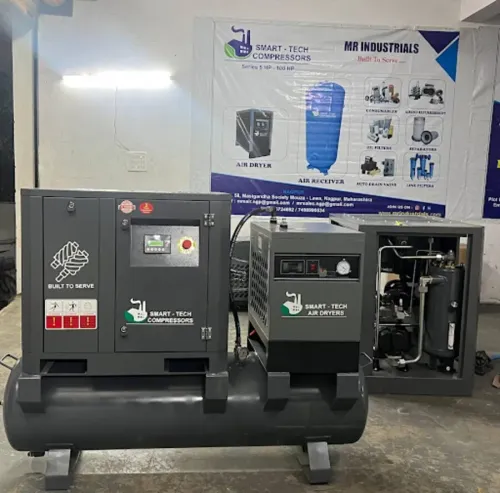
3. For a tank-mounted package, verify the receiver design code, inspection documents, safety-valve rating, corrosion protection, accessible drain and jurisdictional registration. A correctly sized compressor does not make an uncertified or unsafe pressure vessel acceptable.
4. Require separate operating limits for rotary screw and reciprocating compressors. State starts per hour, cooling intervals, permitted unloaded running and continuous-duty expectations; reciprocating units need tighter duty controls, while rotary screws are commonly selected for sustained operation. Ask for full-load and part-load data so low-demand operation does not hide excessive energy use.
Compare Fixed-Speed and VFD Packages Over the Load Cycle
Use hourly demand data to decide between a fixed-speed compressor and a VFD compressor, not the assumption that variable speed always saves energy. A fixed-speed compressor suits a stable base load; VFD compressor selection becomes stronger when demand varies widely without pushing the drive below its minimum stable speed.
| Option | Strengths | Risks and checks |
|---|---|---|
| Fixed-speed compressor | Efficient near full load; simple starter and controls; lower drive-related capital and harmonics treatment | Unloaded power and frequent starts can waste energy; check compressor turndown, starts per hour, unload pressure band, and motor efficiency |
| VFD compressor | Matches output to changing demand; fewer starts and tighter pressure control | Check minimum stable speed, drive efficiency, harmonic mitigation, drive replacement risk, and operation near minimum load |
| Multiple compressors | Sequencing can combine base-load and trim machines efficiently | Poor sequencing creates parallel part-load operation, excessive starts, or one compressor repeatedly carrying trim duty |
Request ISO 1217 package data for full-load and part-load specific power at the plant’s actual pressure profile. Compare part-load specific power, unloaded kW, FAD, tolerances, and motor efficiency at 7, 8, 9, and 10 bar; a machine efficient at 7 bar can consume materially more at 8–10 bar, while unnecessary pressure increases raise electricity use.
Compare total cost across electricity, lubricant, filters, separator elements, dryer power or purge air, preventive maintenance, breakdown labour, and production losses. VFD capital cost, harmonics treatment, drive risk, or weak demand variation can outweigh savings.
Match Air Treatment to the Product and Process
1. Replace “clean air” and “oil-free” with an ISO 8573-1 air quality class written as particles:water:total oil. Use the process as the starting point: packaging often needs 2:4:1, food contact 1:2:1, pharmaceutical processing 1:2:1 or 1:1:1, electronics 1:2:1, and spray painting 1:4:1.
Confirm the target with the product specification; Class 0 is a user-selected concentration limit, not zero detectable oil. Require the test method, sampling location, sample volume, inlet temperature, line pressure, flow, and load condition.
2. Request oil-carryover data, particle ratings, filter stages, and pressure drop at rated flow with both a clean element and the stated replacement condition. Clean-filter figures alone hide the running cost of several coalescing and final filters in series.
3. Compare dryers only by pressure dew point stated with inlet temperature, ambient temperature, pressure, flow, and pressure conditions. A bare dew-point number proves nothing.
| Refrigerated | Lower capital and no purge air | Positive dew point suits general plant air |
|---|---|---|
| Heatless desiccant | Uses purge air, often a substantial share of rated flow | Low dew point; include lost capacity and energy |
| Heated, blower-purge, or heat-of-compression | Less purge, but adds heaters, blowers, controls, capital cost, or discharge-condition dependence | Large or critical systems |
4. Specify auto-drain failure mode, isolation, manual bypass, service access, and drain-failure alarm. Timer drains can waste air; zero-loss drains can fail closed and flood equipment. Include oil-treatment capacity and local discharge rules in the condensate disposal plan.
Read the Warranty as a Scope and Service Contract
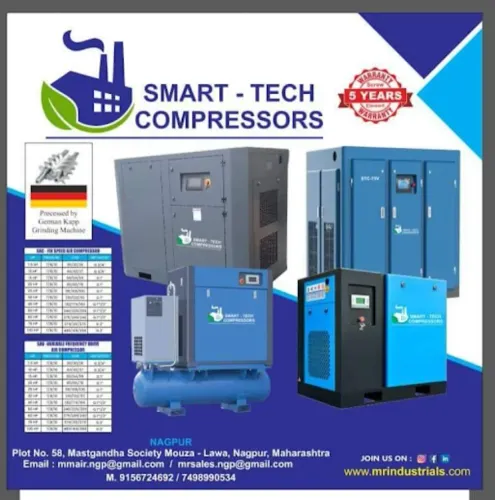
A five-year promise is meaningless until you identify what it covers. Ask whether the airend and motor warranty applies to the complete compressor or excludes the controller, oil separator, bearings, coolers, valves, sensors, VFD, starter, contactors, wiring, and other electrical components.
Before signing, require these compressor warranty terms in the purchase contract:
- State the coverage period for every component, plus exclusions, labour, travel, freight, diagnosis, and guaranteed response time.
- Name the approved lubricant, filter-change interval, maintenance records, ventilation requirements, ambient-temperature and altitude limits, installation conditions, and authorised commissioning procedure.
- Define the claim process: contact, documents, inspection deadline, repair approval, replacement decision, and who pays while the machine is unavailable.
- Request proof of authorised spare parts: a current parts list, component manufacturer references, stock locations, and a documented replacement route for proprietary controllers and drives.
- Require performance-test records, flow and pressure curves, wiring diagrams, manuals, spare-parts lists, maintenance schedules, recommended lubricants, and ISO 1217 commissioning records where applicable.
Treat these conditions as operating obligations, not footnotes. Incorrect oil, missing service records, blocked ventilation, excessive ambient heat, or unauthorised commissioning can void a claim after a failure. Confirm that the supplier can export operating and alarm history; without it, proving the cause of a breakdown becomes slower and more expensive.
A warranty that excludes the separator or controller can leave production stopped for weeks while parts are sourced.
Make Lifecycle Support a Measurable Technical Requirement
A support promise becomes a technical requirement when the purchase order states response hours, parts availability, and escalation routes. Ask each manufacturer to document its compressor lifecycle support before you compare prices.
1. Set a local service response time in hours, name the escalation contact, and require approved service capability for commissioning, diagnosis, and repairs. Confirm stocked wear parts, oil-separator elements, bearings, valves, sensors, and coolers, plus the expected supply period for the airend.
2. Request the controller replacement policy and VFD replacement policy. The document must explain how obsolete electronics are replaced, whether settings can be transferred, and who supports proprietary hardware after production ends.
3. Ask how technicians diagnose faults and export operating and alarm history. Require access to controller logs, fault codes, trend data, and service reports; a failure that cannot be reconstructed will consume production time.
4. Record a compressor commissioning baseline covering flow, pressure, temperature, power, dew point, filter differential pressure, and alarm history. Compare future readings with this record to identify fouled coolers, blocked filters, leakage, dryer decline, or airend wear.
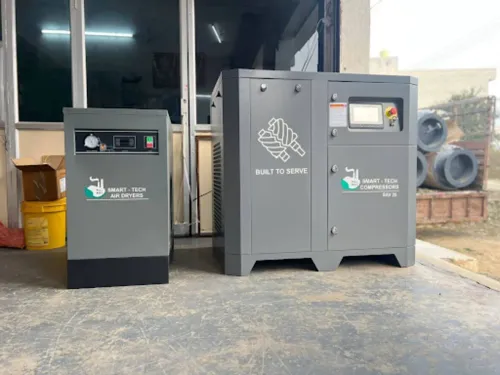
5. Put the complete service plan in writing: compressor, dryer, auto drains, condensate treatment, receiver, filters, and electrical panels. Specify dryer dew point at stated inlet temperature, ambient temperature, pressure, and flow, and match condensate-treatment capacity to duty.
Use this same checklist, evidence, response commitment, and parts-availability test when evaluating SMART - TECH COMPRESSORS or any other candidate. That creates a defensible decision based on production risk and lifecycle cost, not a fast-service claim.
Related products
 | Rotary Screw Air Compressor Smart -Tech Compressors Upto 300 HP We brought Special customised machine for customers , very cost effective and breakdown free , long life with energy saving and low maintenance... |
 | Rotary Screw Air Compressors braught a customised machine for customers very good in Quality , low cost , energy saving , low maintenance cost , fast service availability , and 5... View product → |
Frequently asked questions
How do you verify an industrial screw compressor’s capacity?
Measure average flow, peak flow, pressure profile, leakage, shift pattern, receiver storage and planned expansion before requesting quotations.
When should you compare a fixed-speed compressor with a VFD package?
Compare both across the plant’s complete load cycle, including minimum demand, peak demand, operating hours and pressure requirements.
How do you choose air treatment for an industrial compressor?
Match the dryer, filters, drains and air-quality level to the product, process and required pressure dew point.
What should an industrial compressor warranty cover?
Check the warranty’s covered components, exclusions, operating conditions, maintenance obligations, claim process and response commitments.
How can you measure a manufacturer’s lifecycle support?
Set written requirements for installation, commissioning, preventive maintenance, technician response times, spare-parts availability and service documentation.
Related products
 | Rotary Screw Air Compressor Smart -Tech Make 30 HP Fix Speed Compressor ₹310000 Smart -Tech compressors braught a customised machine for customers very good in Quality , low cost , energy saving , low maintenance cost , fast... |
 | Rotary Screw Air Compressor SMART -TECH MAKE 25 HP VFD COMPRESSOR ₹380000 Smart -Tech compressors braught a customised machine for customers very good in Quality , low cost , energy saving , low maintenance cost , fast... |
 | Tank Mounted 10HP TANK MOUNTED MODEL FOR PACKAGING INDUSTRIES Tank mounted complete package rotary screw air compressor specially built for small industries with affordable prices and service. |
 | Rotary Screw Air Compressor 50HP SMART -TECH VFD COMPRESSOR PREMIUM MODEL PREMIUM RANGE ROTARY SCREW AIR COMPRESSOR 50HP VFD MODEL WITH VERY AFFORDABLE PRICE AND MORE WARRANTY THAN ANY BRAND |