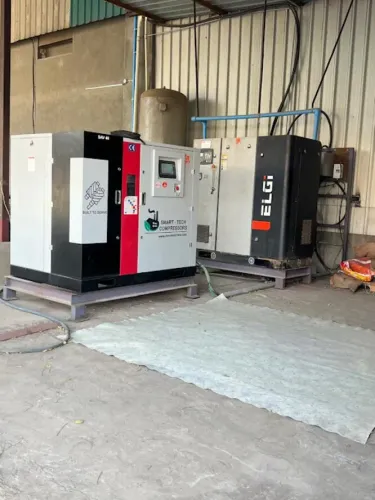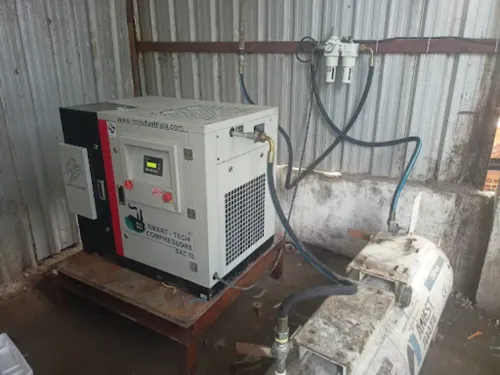
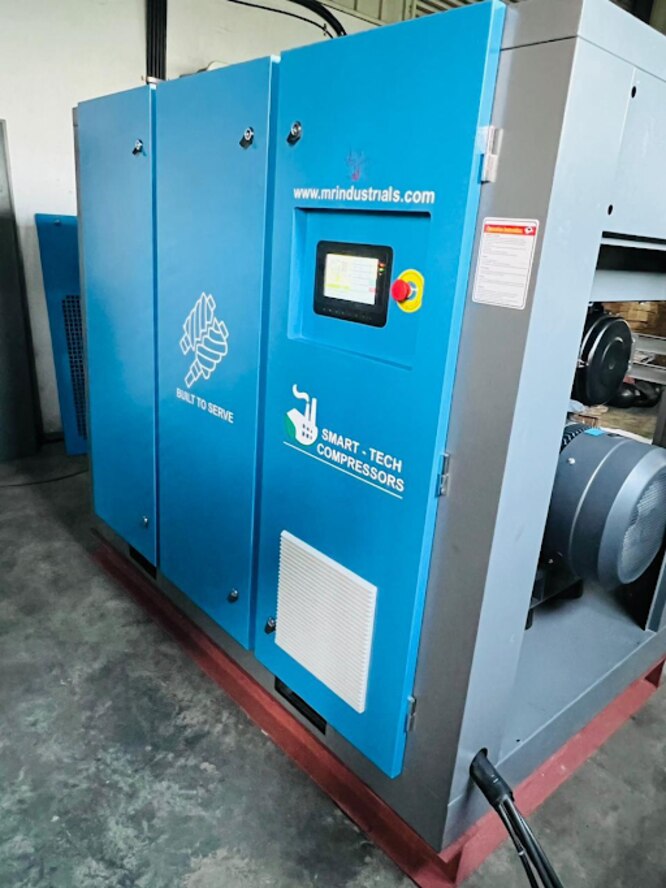
Compressed air can move product, open valves, fill containers, clean packaging, and position components, but the required air quality changes with each task. By the end, you will be able to classify each use, specify ISO 8573-1 requirements, size the supply, and compare a packaged system with a separate receiver and treatment train.
Key takeaways
- Classify air by whether it contacts food or packaging interiors.
- Specify ISO 8573-1 purity classes before comparing compressors.
- Size the compressor and receiver against measured demand, not connected load.
- Test air quality and manage condensate after installation.
Match compressed air to the food-industry task and contamination risk
An air compressor for food industry operations may supply bottle and pouch cleaning, filling, capping, labelling, conveying, pick-and-place equipment, control valves, pneumatic tools and actuators. The task determines the contamination risk: air that touches exposed food or the inside of packaging is a product-contact utility, while air driving a cylinder remains outside the product zone.
| Air role | Typical operations | Main risk | Treatment priority |
|---|---|---|---|
| Direct-contact air | Blowing food, cleaning bottles or pouches, purging filling heads | Oil, water, particles or microorganisms can reach food or packaging interiors | Highest air-quality control and point-of-use verification |
| Indirect-contact air | Actuators, control valves, pick-and-place units, external conveying | Leaks, valve exhaust, seal failure or maintenance debris can reach the line | Controlled plant air with protected exhaust and clean maintenance practices |
| Plant air | Pneumatic tools and equipment outside the production zone | Contamination affects equipment more than the product, unless airflow migrates into the process | Suitable general utility air, kept separate from product-contact circuits |
Packaging automation often combines all three categories on one machine. A cylinder may use indirect-contact air, but an air blast aimed at an open pouch changes the requirement immediately.
Do not treat “food-grade lubricant” as proof that discharge air is safe for direct contact. It addresses incidental-contact lubricant suitability, not oil aerosol, vapour, liquid water, particles or microorganisms in the air.
An oil-free compressor also does not guarantee sterile air; intake conditions, piping, filters, receiver corrosion and failed drains can change quality before air reaches the process. Sample at that point of use.
Specify air quality with ISO 8573-1 before choosing a compressor
Write the requirement as an ISO 8573-1 class before selecting the compressor. The class has three figures: particles, water and oil, written in that order. Specify the limit for each contaminant, the sampling point and the operating condition; “clean air” is not a measurable purchase specification.
| Air category | What the specification must control | When it applies |
|---|---|---|
| Direct-contact air | Particle class, oil aerosol and vapour limits, pressure dew point, plus separate microbiological limits | Air touches exposed food, an open container or product-contact surface |
| Indirect-contact air | Particle, water and oil limits that prevent contamination after leaks, bursts or contact with packaging surfaces | Air acts near open product or its packaging without deliberately touching it |
| Plant air | Limits matched to equipment reliability, corrosion control and worker safety | Actuators, conveying, tools and controls away from exposed product |
Set water by pressure dew point at line pressure, not atmospheric dew point. ISO 8573-1 examples are −70°C for Class 1, −40°C for Class 2, −20°C for Class 3 and +3°C for Class 4.
Specify microbiological control separately through hazard analysis, customer requirements and validation. Define the organisms or total count, sampling method, location and acceptance limit; ISO 8573-1 has no microbiological purity class.
Do not treat “oil-free” or Class 0 as sterile. Class 0 means the manufacturer specifies a stricter oil concentration than Class 1, not zero contamination under every condition. A food-grade lubricant also does not make discharge air suitable for direct contact.
Build the downstream treatment train from the compressor to the point of use
A typical train runs from compressor to aftercooler, moisture separator, receiver, prefilter, dryer, coalescing filter, activated-carbon filter and final point-of-use filter. Each stage removes a different threat; skipping one shifts the load to the next filter and increases pressure loss.
| Component | Main control | Placement and consequence |
|---|---|---|
| Aftercooler | Heat and liquid water | Immediately after compression; without it, hot air carries more vapour downstream. |
| Moisture separator | Bulk condensate and droplets | After the aftercooler and receiver; a blocked drain sends water into the line. |
| Coalescing filter | Oil aerosol, liquid water and fine particles | Downstream of the dryer or as specified by the manufacturer; saturation causes pressure drop and breakthrough. |
| Dryer | Water vapour and pressure dew point | Select for the coldest pipe location, peak flow and seasonal intake; +3 °C pressure dew point can fail in a colder area. |
| Activated-carbon filter | Oil vapour and hydrocarbon odour | After coalescing filtration; exhausted carbon passes vapour without an obvious pressure change. |
| Sterile-grade final filter | Fine particles and microorganisms | At the food-line connection; install a validated, integrity-tested membrane filter and protect it from condensate. |
Use automatic drains on separators, receivers and filters, then test them. Float and timed drains can waste air or fail closed from scale, oil or dust; zero-loss electronic drains still need strainers and a response plan.
Sample air at the point of use, not only at the compressor outlet. ISO 8573-1 covers particles, water and oil, while microbiological control requires separate hazard-analysis, validation and maintenance requirements. A food-grade lubricant does not make oil-lubricated discharge air safe for direct product contact.
Size the compressor, receiver, dryer, and distribution system for real demand
Start with a 24-hour demand log, not the motor rating. Record each machine’s free air delivery requirement at its operating pressure, running time, duty cycle and start-up surge.
Add simultaneous loads, estimate leakage, and size for peak demand rather than the daily average; leave capacity for future equipment and pressure losses through filters, hoses and valves.
For a short air burst, calculate receiver tank volume with V = Q × t × Patm ÷ (Pmax − Pmin). Use Q in cubic metres per minute, t in minutes, and absolute pressures. This estimates the air available during the permitted pressure swing and response time.
A larger receiver reduces cycling and covers a brief blow-off; it cannot support a sustained load that exceeds compressor FAD.
Tank-mounted and separate arrangements solve different installation problems.
| Option | What it means | When it applies |
|---|---|---|
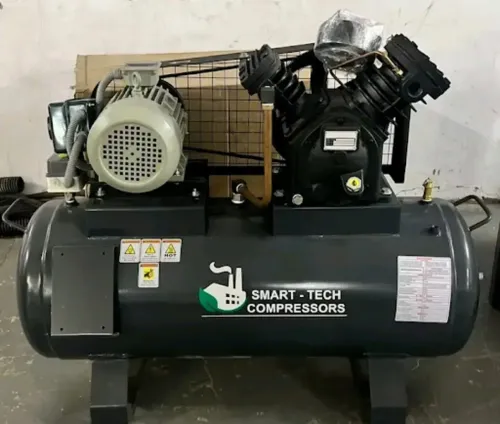
| Tank-mounted package | Compressor and receiver in one compact assembly; simpler installation but limited receiver volume and treatment layout | Small packaging lines with stable demand and short peaks |
| Separate receiver and treatment train | Compressor, receiver, dryer, filters and drains sized independently | Multiple lines, high peaks, strict air quality, or future expansion |
| Hybrid system | Tank-mounted unit plus a correctly sized downstream receiver and treatment | Existing package needs surge capacity without replacing the compressor |
Size the dryer for maximum flow, hottest intake conditions and the coldest downstream location. Specify the pressure dew point there; +3 °C is unsafe where piping sees colder temperatures. SMART - TECH COMPRESSORS should quote FAD at operating pressure, receiver volume, dryer pressure loss and control-band data, not horsepower alone.
Include a ring main with correctly sized branches so pressure drop does not starve the packaging machine.
Related products
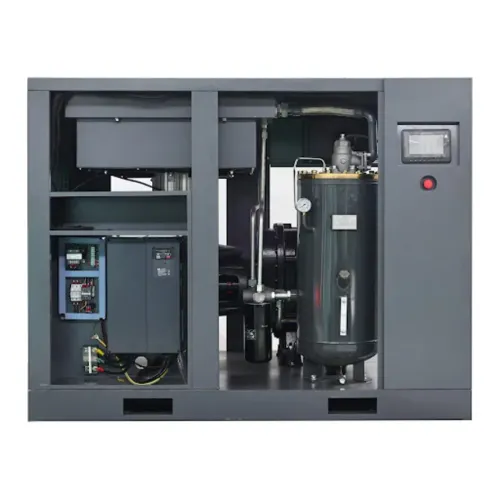
 | Tank Mounted 10HP TANK MOUNTED MODEL FOR PACKAGING INDUSTRIES Tank mounted complete package rotary screw air compressor specially built for small industries with affordable prices and service. |
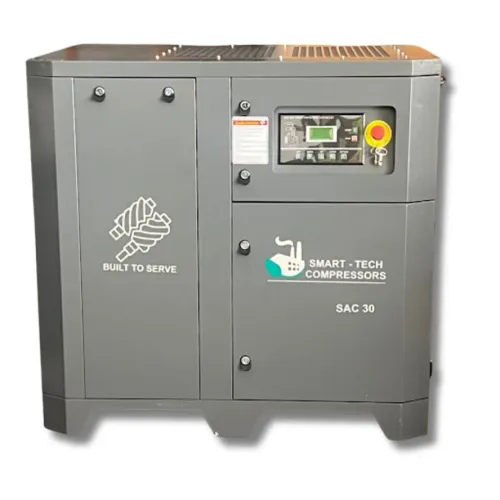
 | Rotary Screw Air Compressor Smart -Tech Compressors Upto 300 HP We brought Special customised machine for customers , very cost effective and breakdown free , long life with energy saving and low maintenance... |
Verify air quality, condensate handling, and reliability after installation
A clean compressor outlet does not prove clean air at the packaging machine. Air-quality verification must sample at the point of use, because piping, receiver corrosion, filter bypasses, damaged seals, maintenance work and intake contamination can change the result downstream.
After commissioning, establish a baseline at the processing or packaging connection. Test the specified ISO 8573-1 classes at operating flow and pressure, then repeat after major maintenance, filter changes or contamination events. Add microbiological testing when air contacts an open product or its packaging.
Request and retain these records:
- A laboratory report identifying the sampling point, date, operating conditions and ISO 8573-1 results
- Filter datasheets showing rated flow at actual inlet pressure, maximum differential pressure and element replacement limits
- Sterile-grade filter integrity, sterilisation or replacement records, including the approved interval
- Dryer dew-point records, receiver inspection documents and automatic drain valve test results
- Compressor service logs, intake-filter changes, leak repairs and calibration certificates for pressure and dew-point instruments
A sterile-grade filter is point-of-use filtration, not a cure for wet or dirty pipework. Prefiltration, correct flow, temperature control and condensate removal prevent loading and stop the filter becoming a contamination reservoir.
Test every automatic drain valve for discharge and failure response. A zero-loss electronic drain still needs a clean strainer and a documented response to a blocked or failed valve; a closed drain can flood filters and send liquid toward the line.
Frequently asked questions
How do you match compressed air to a food-industry task?
Separate product-contact air from utility air. Air entering exposed food or packaging interiors needs stricter contamination control than air operating an external cylinder, valve or tool.
What does ISO 8573-1 specify for food-processing compressed air?
ISO 8573-1 classifies compressed air by particles, water and oil. Specify the required class for each point of use before selecting the compressor and treatment equipment.
Which treatment equipment belongs after the compressor?
Build the train around the risk and pressure requirement: aftercooler and separator, receiver, filters, dryer, condensate management and point-of-use filtration where needed.
How should you size a food-processing compressed-air system?
Measure actual flow, pressure, duty cycle and peak demand. Size the compressor, receiver, dryer and distribution piping for those figures rather than adding the consumption ratings of every connected machine.
Related products
 | Rotary Screw Air Compressor SMART -TECH MAKE 25 HP VFD COMPRESSOR ₹380000 Smart -Tech compressors braught a customised machine for customers very good in Quality , low cost , energy saving , low maintenance cost , fast... |
 | Rotary Screw Air Compressor Smart -Tech Make 30 HP Fix Speed Compressor ₹310000 Smart -Tech compressors braught a customised machine for customers very good in Quality , low cost , energy saving , low maintenance cost , fast... |
 | Rotary Screw Air Compressor 50HP SMART -TECH VFD COMPRESSOR PREMIUM MODEL PREMIUM RANGE ROTARY SCREW AIR COMPRESSOR 50HP VFD MODEL WITH VERY AFFORDABLE PRICE AND MORE WARRANTY THAN ANY BRAND |
 | Auto Drain Valves Auto Drain Valves Low & High Discharge Auto Drain Valves |