Continuous production depends on more than choosing a compressor with enough horsepower. You need to match air demand, pressure, heat removal, oil management, controls and backup capacity so the machine stays within its operating limits while delivering usable air. By the end, you will be able to evaluate whether an oil-injected screw compressor and its supporting system are suitable for your duty profile.
Key takeaways
- Use oil circulation to lubricate, seal and cool the airend.
- Match compressor capacity to measured demand, not connected equipment nameplates.
- Control discharge temperature, moisture and condensate before they damage equipment.
- Trend pressure, temperature and oil data to detect faults early.
How injected oil keeps the airend running continuously
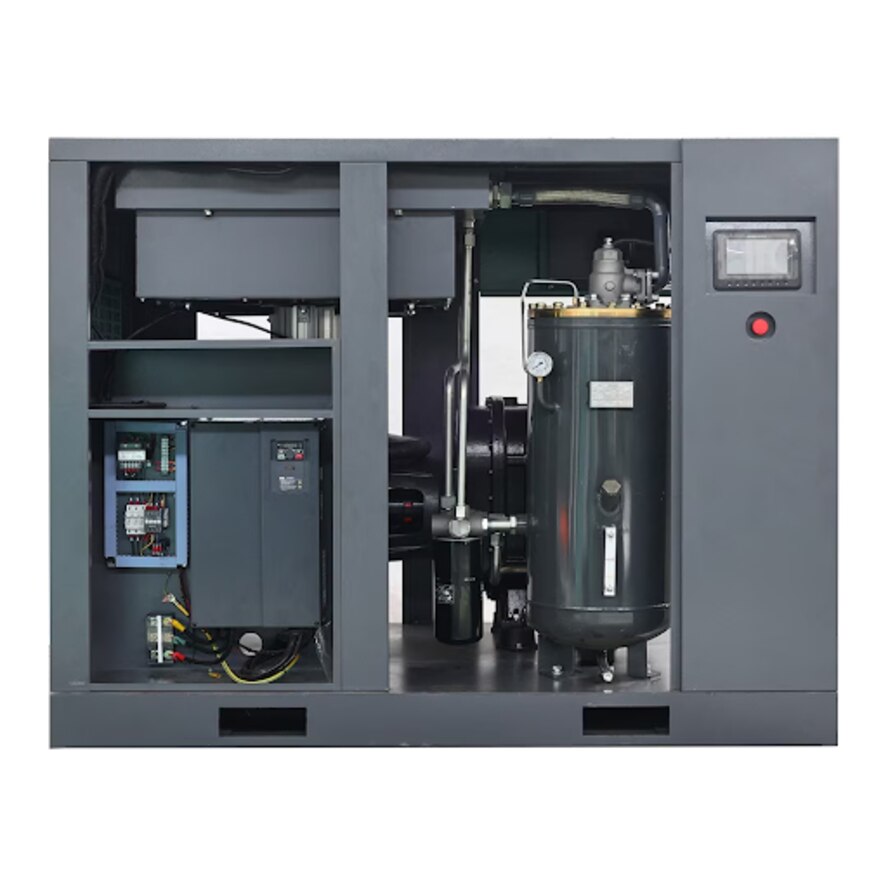
Injected oil lets an oil injected screw air compressor run for long periods by providing lubrication of bearings and rotors, sealing internal clearances, and carrying away heat from compression inside the airend. This reduces friction, leakage and discharge temperature.
If oil flow stops, the viscosity is wrong, or replacement oil is incompatible, temperature can rise rapidly while compression efficiency falls.
Continuous-duty applications require more than a compressor rated to run continuously. Define the required operating hours, loaded and unloaded periods, air-demand profile, acceptable blow-off time and maximum starts per hour. Keep the machine within its specified pressure, ambient-temperature, speed and thermal limits; continuous duty still includes unloading, inspections and planned service.
Use this checklist before treating a machine as continuously suitable:
- Confirm the manufacturer’s duty rating at your working pressure and ambient temperature.
- Match capacity to the real demand profile, including minimum demand and peak demand.
- Check that unloaded running, starts per hour and restart controls suit the installation.
- Verify oil level, circulation, cooling and the specified oil type and viscosity.
- Treat discharge air separately: an oil-injected compressor is not oil-free without correctly selected downstream filtration.
- Provide condensate treatment; oil-contaminated condensate must not be discharged untreated.
The oil circuit points that determine reliability
Inspect the oil circuit for restriction, leakage and contamination before an alarm becomes a shutdown. Oil level alone proves little: a blocked return path or cooler can overheat a correctly filled compressor.
| Component | Failure clue | Consequence and check |
|---|---|---|
| Oil separator vessel | Oil mist at the outlet or rising separator pressure | Check vessel seals, connections and pressure readings for leaks or abnormal backpressure. |
| Separator element | High differential pressure, oil carryover or rapid oil loss | Inspect the element and gasket; confirm correct installation and replace it at the measured pressure limit. |
| Oil filter | Rising differential pressure or falling oil flow | Replace the filter with the specified element before restricted flow damages bearings and rotors. |
| Oil cooler | High discharge temperature with a normal oil level | Clean the cooler core and verify airflow or cooling-water flow; blocked fins trap heat. |
| Thermostatic valve, minimum-pressure valve and scavenge line | Slow warm-up, unstable pressure or oil collecting downstream | Test valve operation and clear the scavenge orifice and return line. |
An automatic drain also protects the circuit’s air treatment. A failed-open drain wastes air; a failed-closed drain fills filters, separators and low points with oil-contaminated condensate. Select it for condensate volume, minimum pressure, freezing risk and serviceable strainer access, then route condensate through an oil-water separator or approved treatment system.
Use only the lubricant, viscosity, fill quantity and change interval specified for the compressor model.
Sizing flow, storage and controls for the real demand profile
Size capacity from measured free-air delivery at the required working pressure, after allowing for dryer, filter and piping losses. Capture normal demand, peak demand and air leakage separately; a compressor that covers average demand can still let pressure collapse during a sustained production surge. Confirm the peak’s duration, not just its highest reading.
| Control | Best fit | Main check |
|---|---|---|
| Fixed-speed | Steady demand or multiple compressors sequenced together | Provide a receiver and control band that limit unloaded running; the motor and auxiliaries still consume power while unloaded. |
| Variable-frequency drive | Demand that rises and falls repeatedly | Match the drive’s minimum and maximum speeds to the load profile; running below its stable minimum can impair oil circulation, cooling and control stability. |
Size the receiver for demand duration, allowable pressure swing and control strategy. Use wet storage before the dryer and dry storage after it when the process needs treated air; storage absorbs short spikes but cannot replace compressor flow during prolonged demand.
Measure pressure at the point of use before increasing compressor set pressure. A dirty filter, restrictive dryer, partially closed valve or failed drain can create local pressure loss, while higher pressure increases power use and air leakage.
Keeping temperature, air quality and condensate under control
Protect the installation by controlling ambient temperature, inlet temperature, humidity, dust and cooling airflow within the compressor manufacturer’s limits. Cold conditions, low load and an oversized machine can keep oil temperature too low, allowing water to condense, emulsify the lubricant and corrode the oil circuit. Excessive heat oxidizes oil and can trigger discharge-temperature protection.
| Condition | Control | Consequence of neglect |
|---|---|---|
| Ambient and inlet temperature | Keep intake air clean, shaded and within the specified range; maintain cooler airflow | Hot intake air reduces capacity, while cold operation promotes water contamination |
| Oil and discharge temperature | Verify thermostatic control and trend discharge temperature; prevent prolonged low-load running | Low oil temperature causes emulsification; high discharge temperature degrades lubricant and trips the compressor |
| Compressed-air quality | Define the required ISO 8573-1 oil class, then size coalescing, particulate or adsorption treatment to achieve it | Separator elements remove bulk oil, not every aerosol or vapour; production contamination follows |
| Condensate | Route drains to an oil-water separator or approved treatment system | Oil-contaminated condensate must not enter wastewater untreated, regardless of the air-quality rating |
Check automatic drains, separator differential pressure and filter differential pressure. A blocked drain floods downstream equipment; a restricted separator raises energy use and temperature. Keep the scavenge return clear, and adjust service intervals for dust, humidity, lubricant and actual load.
Using trends and redundancy to protect uptime
A rising trend is an earlier warning than a missed calendar service date. Review the compressor controller weekly and compare readings against its normal baseline; adjust service intervals for dust, humidity, operating pressure, lubricant and actual load.
- Discharge temperature: a steady increase points to restricted cooling, poor oil flow or rising compression stress.
- Separator differential pressure: a rise indicates a restricted separator element or scavenge-return problem, increasing energy use and oil loss.
- Motor current: increasing current at the same pressure and flow signals mechanical or airend deterioration.
- Loaded and unloaded time: excessive unloaded running wastes power and can expose poor sequencing or oversized capacity.
- Pressure profile and condensate-drain behavior: unstable pressure or a failed-open drain indicates leakage or control trouble; failed-closed drains allow water and oil to collect.
Protect supply at the system level. Use lead-lag sequencing with automatic standby capacity, isolation valves and enough receiver volume to carry essential loads while one compressor is serviced. Provide a parallel dryer or treatment path when a single dryer failure would stop production.
Test the standby machine under load, confirm drain operation, and record recovery pressure before an outage occurs. Trend alarms rather than resetting them repeatedly; a separator alarm, high temperature or rising motor current deserves planned intervention before it becomes a shutdown.
What to request before selecting an installation
Before approving a continuous-duty installation, require model-specific data for delivered free air, rated pressure, ambient-temperature limits, minimum stable speed, maximum starts per hour and permitted loaded-to-unloaded cycling. A catalogue motor size is not enough; compare performance at your actual pressure and demand profile.
| Supplier evidence | Why it matters | What to clarify |
|---|---|---|
| Free-air delivery curve | Shows capacity at operating pressure | Ask for test conditions and tolerances |
| Speed range and control logic | Prevents operation below the minimum stable speed | Confirm turndown, unloading and restart behaviour |
| Manufacturer oil specification | Protects bearings, rotors, seals and separator performance | Record oil grade, fill quantity and approved alternatives |
| Service schedule and service intervals | Connects maintenance to dust, heat, humidity and load | Request parts, labour and downtime assumptions |
| Support coverage and response process | Limits the impact of a fault | Confirm technician availability, spare-parts stock and escalation contacts |
Also request trend logging for discharge temperature, motor current, separator and filter differential pressure, oil condition, loaded time and condensate-drain events. Ask for commissioning records that prove rotation, cooler airflow, drain operation and pressure settings.
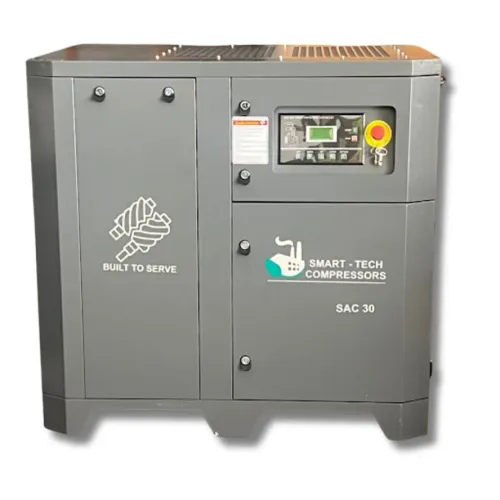
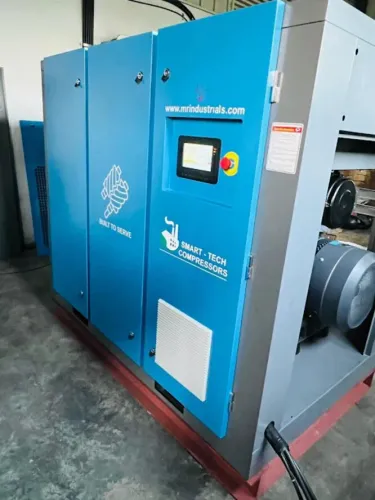
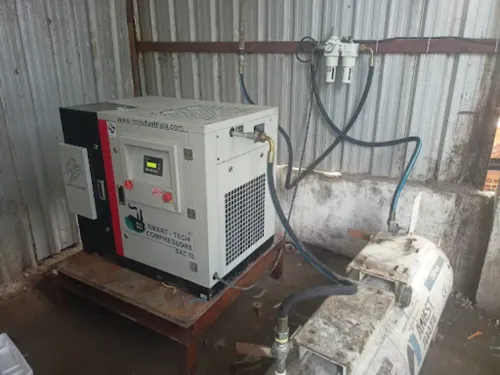
SMART - TECH COMPRESSORS should provide the selected model’s operating envelope and a written service plan; compare those documents against competing offers, not just the quoted horsepower. Reject any proposal that leaves oil changes, separator replacement, emergency response or maximum ambient temperature unspecified.
Related products
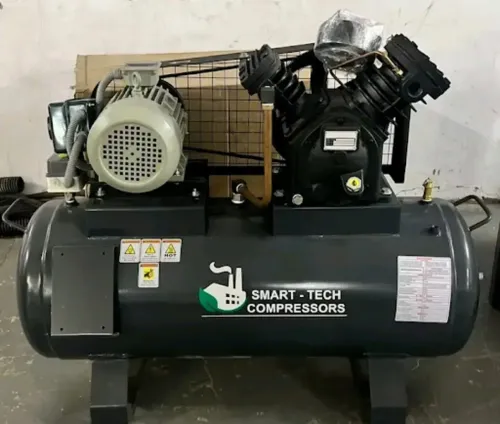
 | Tank Mounted 10HP TANK MOUNTED MODEL FOR PACKAGING INDUSTRIES Tank mounted complete package rotary screw air compressor specially built for small industries with affordable prices and service. |
 | Rotary Screw Air Compressor Smart -Tech Compressors Upto 300 HP We brought Special customised machine for customers , very cost effective and breakdown free , long life with energy saving and low maintenance... |
Frequently asked questions
How does injected oil keep a screw compressor running continuously?
The oil lubricates bearings and rotors, seals internal clearances and carries compression heat away from the airend.
Which oil-circuit points determine compressor reliability?
Inspect the oil separator, filter, cooler, thermostat, scavenge line and oil level because restrictions or poor separation affect lubrication and temperature.
How should you size flow, storage and controls for continuous-duty demand?
Base capacity on a measured demand profile, account for peak flow and pressure losses, and use receiver storage and controls to prevent inefficient cycling.
How do you control temperature, air quality and condensate?
Keep cooling surfaces clean, select suitable filtration and drying, and drain condensate from receivers, filters and dryers reliably.
What should you request before selecting an installation?
Request the duty cycle, flow and pressure data, air-quality requirement, ambient conditions, electrical supply, service access and a documented control and redundancy plan.
Related products
 | Rotary Screw Air Compressor Smart -Tech Make 30 HP Fix Speed Compressor ₹310000 Smart -Tech compressors braught a customised machine for customers very good in Quality , low cost , energy saving , low maintenance cost , fast... |
 | Rotary Screw Air Compressors braught a customised machine for customers very good in Quality , low cost , energy saving , low maintenance cost , fast service availability , and 5... View product → |
 | Rotary Screw Air Compressor SMART -TECH MAKE 25 HP VFD COMPRESSOR ₹380000 Smart -Tech compressors braught a customised machine for customers very good in Quality , low cost , energy saving , low maintenance cost , fast... |
 | Rotary Screw Air Compressor 50HP SMART -TECH VFD COMPRESSOR PREMIUM MODEL PREMIUM RANGE ROTARY SCREW AIR COMPRESSOR 50HP VFD MODEL WITH VERY AFFORDABLE PRICE AND MORE WARRANTY THAN ANY BRAND |